
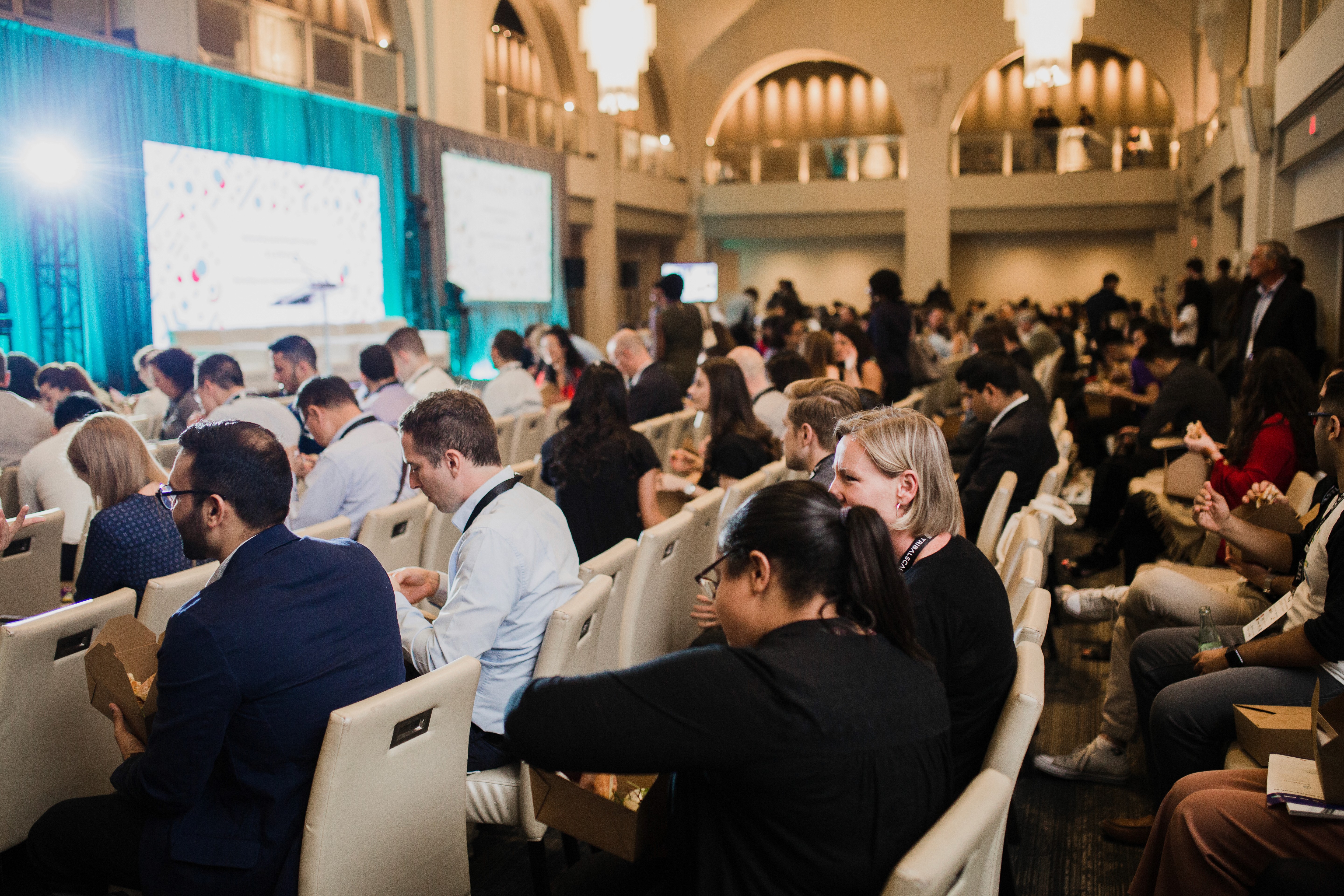
In 2017, we rented out the Arcadian Court, booked 30 speakers from six countries, and called it TakeOver. We had no idea if anyone would show up. Over 800 people did. That’s not where this story starts, but it’s where TribalScale’s part of it does.
Toronto’s tech collaboration scene didn’t emerge from a master plan. It was built event by event, by practitioners who got tired of waiting for someone else to create the gathering they actually wanted to attend.
The early 2000s marked the beginning of a community-driven culture that would come to define the city’s tech identity. FITC, the design and technology events organization founded by Shawn Pucknell in 2002, became an early fixture - starting as a Toronto Flash user group before growing into an internationally recognized conference series spanning more than 26 cities over two decades.
Alongside these early events, government investment began laying the structural foundation. MaRS opened in 2005 with federal, provincial, and municipal backing. The federal government eventually formalized its AI ambitions through the 2017 Innovation Superclusters Initiative, co-investing in the Vector Institute for AI alongside the University of Toronto, which quickly became a globally recognized centre for deep learning research and a magnet for talent and capital.
The 2010s brought a surge of startups and investment, and the community’s events culture accelerated with it. Nowhere was that more visible than at Xtreme Labs, which was doing more than building apps — it was building a community of product-focused engineers. Founded in 2007 by Amar Varma and Sunny Madra, Xtreme built mobile products for clients including Facebook, Twitter, MTV, Mercedes-Benz, American Express, and CBS Sports, before growing to a team of 300. Community was in the company’s DNA. Xtreme ran on agile engineering principles - pair programming, flat hierarchy, a “Do-ocracy” mantra - and exported that culture into the broader Toronto tech scene through DemoCamp sponsorships, speaking appearances, and a reputation as the kind of shop developers wanted to work at and learn from. When Pivotal acquired Xtreme in October 2013, it validated that Toronto could produce companies worth acquiring at a global scale. Sheetal Jaitly, who had served as Director of Business Development at Xtreme and later expanded into Telecommunications and IoT under Pivotal, went on to found TribalScale in November 2015.
TechTO was doing the work that doesn’t show up in press releases during this same stretch. Co-founded by Alex Norman and Jason Goldlist, TechTO built itself around a simple but hard-to-replicate premise: a monthly gathering that combined TED-style talks from practitioners with a community open mic, giving anyone in the room a moment to say what they were working on. Norman and Goldlist started TechTO to help accelerate the Canadian tech ecosystem. The format worked. Early attendees included founders who would go on to build companies like Wealthsimple and Hostaway, people who credit those early TechTO rooms as pivotal moments in their careers. Today TechTO draws together founders, operators, investors, and builders from across Canada’s tech scene, and is a partner organization for Toronto Tech Week 2026. The organization’s power has always been relational: it gives the ecosystem a regular, low-barrier place to find each other.
TribalScale didn’t just want to build great products, we wanted to shape the conversation happening around innovation in Toronto. In 2017, we launched the TakeOver Innovation Conference. TakeOver brought together 600 digital transformation executives, investors, entrepreneurs, and senior technology leaders from around the world to discuss how technology was driving the innovation agenda within companies. The inaugural event covered three concurrent tracks - Human Innovation, Industry Innovation, and Economic Innovation - with speakers from companies including Emirates Airlines, NBCUniversal, and Viacom. We did our first TakeOver in 2017 with over 800 attendees. We were also deliberate about who was on stage: at the 2017 edition, 53% of speakers were female, making TakeOver one of the first conferences in Canada to formally exceed gender parity in its speaker lineup. TakeOver was also one of the first technology conferences in Canada to have a formal Diversity Mandate, with a commitment to equal representation and inclusiveness for speakers and attendees.
In 2018, we brought TakeOver back for a second year on June 11th at the Arcadian Court and Loft. This time we sold out, with 1,700 people attending. TakeOver 2018 featured more than 40 speakers, three full stages running simultaneously, hands-on workshops, lightning talks, and interactive demos, covering disruption across media, sports, retail, financial services, automotive, and healthcare. We also used the conference as the launch platform for our Venture Studios program, showcasing its first cohort of startups. TakeOver was proof that you could build a world-class innovation event in Toronto, bring a global network into the room, and make sure that room actually reflected the community you were trying to build.
Toronto was also becoming a destination for internationally recognized conferences. Collision is organized by Web Summit, the global conference company founded by Paddy Cosgrave. What began as a small annual gathering in Dublin in 2010 grew into a portfolio of global events. Collision started as its North American edition, running first in Las Vegas before moving to New Orleans, and then to Toronto. In 2019, Collision arrived in Toronto for the first time, welcoming more than 25,700 attendees from 125 countries to the Enercare Centre at Exhibition Place, the first time the conference had been held outside the United States. The City of Toronto, Destination Toronto, and Exhibition Place partnered to bring it here, using the conference to attract foreign direct investment, promote international trade, and spotlight Toronto’s innovation ecosystem to a global audience. At the Toronto Inc. Pavilion each year, City leaders - including mayors and the City’s CTO - have shown up on the conference floor to make the case for Toronto as a place to build. That’s a meaningful signal: government treating a tech conference not as a photo opportunity, but as economic development infrastructure.
The broader arc of government engagement in Toronto’s tech scene has been that shift: from passive to participatory, after the community put in the work to demonstrate its collective influennce. The City of Toronto sponsored TechTO events. The federal government backed the Vector Institute and channelled hundreds of millions through FedDev Ontario into southern Ontario’s AI ecosystem. And for Toronto Tech Week, the commitment became explicit and multi-year. Toronto Tech Week returns May 25–29, 2026, backed by a new multi-year partnership with the City of Toronto signalling a shared, long-term commitment to the city’s innovation economy, talent retention, and global competitiveness. Mayor Olivia Chow put it directly: “Toronto is a global tech hub, and that means real jobs, real growth, and real economic impact to neighbourhoods throughout the city.” Founding sponsors include Shopify, Google for Startups, and the City of Toronto itself.
The 2025 debut brought together more than 15,000 attendees across 315 events and 500 speakers spanning 27 neighbourhoods, making it the largest grassroots tech gathering in Canada. This year, Toronto Tech Week is expected to host more than 300 events across the city, from the Homecoming mainstage to founder dinners, workshops, runs, and meetups in neighbourhoods across Toronto.
The throughline from the early meetups to this week is the same: people who cared enough to build something worth gathering around, and institutions that eventually caught up. When you’re out networking at events this week, keep an ear open for these stories and dive more into the history of the industry in Toronto. Many of these same early days participants are still actively engaged in this week’s festivities.
Did we miss a story about early days of tech events? Reply to let us know!